
Access your workbooks, assignments and other downloads here.
NOTE: In order to save your work, download the PDF files to your computer and then you may enter your info. You'll lose your work if you make edits without first downloading the PDF.
05.02: Elements of Design
Download your workbooks to follow along with the lesson
What Makes Up Composition?
You’ve probably heard that phrase before “the elements of design,” so what does it mean?
The elements are not specific to photography, they are universal across all art forms. They are all the stuff/the matter that take up space on the canvas or in this case fill the frame. Every tangible and intangible piece of visual information falls within one of the elements of design and becomes a tool you can use to help build composition. Let’s go over the elements!
- Point
- Line
- Shape/Form
- Space
- Texture
- Color
- Pattern
Point
A point is considered to be a small area of interest that the eye is drawn towards. This might be singular or it could be an intersection, a spot where multiple areas of interest meet.
They give us a focal point and draw our attention, adding structure to an image.
Here, our eye is drawn to a central point in the image. This point is created by two different moments of intersection. One, is created by the touching of hands, and the other, by the diagonal crossing of the produce.

Line
Lines can be thought of as the guides of a photo. They are like a path for the eyes to follow or in some cases a boundary. They may connect two parts of an image or they may stretch across it. What’s important to note is that there are instances where they are clear and visible like the horizon line or a road, but they may also be imaginary, like the way a viewer’s eyes follow the gaze of a person in a photo to see what they’re looking at.
They either connect parts of a photo to each other, adding intention, or they guide the eye to what is meant to be focused on.
In this image we have both physical and implied lines. Physical line is created by the stacks of cheese slices. Their layers and edges create multiple lines for the eye to follow inward. An implied line is established by the space left between the stacks. You can see a zig-zag pathway cutting vertically down the middle.

Shape/Form
While not the same, shape and form can be paired together because they are a part of each other. Shape is 2-dimensional while form is 3-dimensional.
Shapes are created by the objects in an image. You can think of them as like an outline. Draw a line around an object with your eye and it creates a shape, or more conceptually, look at the gaps around an object/objects, they take on a sort of shape.
Every shape has the power to attract attention and evoke some sort of emotion, like how a circle might feel peaceful. Form on the other hand is created by light and in turn, shadow. When light hits a shape it becomes a 3D form with variations of light and dark that make it stand out from its surroundings.
Each shape/form has the ability to attract a viewer and convey emotion.
In this image we have both physical and imaginary lines. Physical line is created by the stacks of cheese slices. Their layers and edges create multiple lines for the eye to follow inward. An imaginary line is established by the space left between the stacks. You can see a zig-zag pathway cutting vertically down the middle.
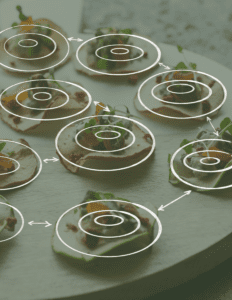
This first example is an overhead shot that illustrates how every object you place in a frame takes on its own shape. Of course these are all three-dimensional objects/forms but when arranging a composition it's helpful to visualize what shape each form takes on.
With a large variety of shapes placed within this frame, the viewer gets the sense that this could be a large gathering of people with food for everyone!
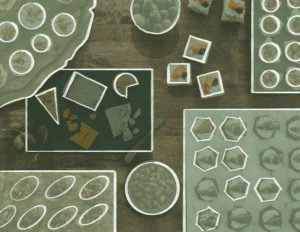
In this second example, there is a ranging display of ingredients. By arranging them in a circular motion, these ingredients that seem random at first start to feel harmonious. The viewer gets the sense that they belong together as part of a recipe.

Space
When describing space, you can break a photo into two parts, positive and negative. The areas that have significant visual weight, or the subjects, are considered positive space. The areas surrounding or in-between subjects are considered negative space. The negative space is usually what gets the most attention because it controls how we view the subject.
Controlling the space in a photo can establish the presence and dynamics of your subjects while also amplifying a feeling/emotion.

Leave little negative space: the subject fills a lot of the frame and feels important.
Leave a lot of negative space: the subject becomes minuscule and small.
In the image to the left, the ratio of positive to negative space is pretty even so our subject feels important with plenty of breathing room.

Space can also affect the dynamic of an image.
High positive space: can feel chaotic and crowded
High negative space: can feel vacant and empty
In this photo, a lot more of the frame is filled with our subject, making it feel significant, but with just enough negative space, the frame isn't crowded.
Texture
Texture is what gives a photo dimension, and can appeal to the senses by making an image seem tactile. Like form, how light hits a texture will affect how we see it and give it its 3 dimensional quality.
In an abstract narrative, a texture could be the star of the show or the subject, but in most scenarios, its purpose is to add interest to the subject or fill gaps that would otherwise feel empty.
Texture has the ability to affect the overall mood of a photo as well. For example, the appearance of soft linen might make us feel calm, or rugged stone might evoke feelings of danger or harshness.
It can draw extra attention to a subject and its quality, add extra dimension, or influence the tone/mood of a photograph.
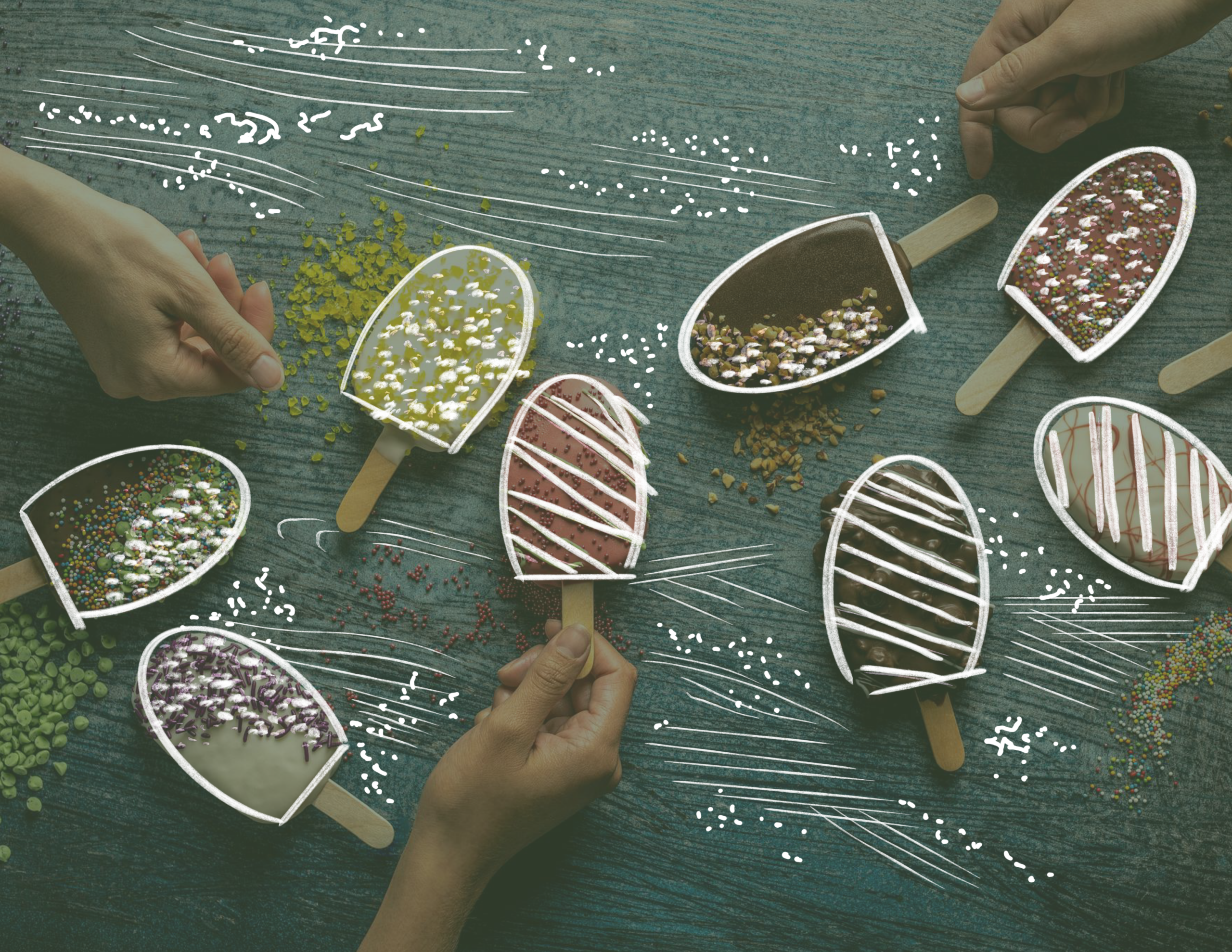
Here we have a very whimsical assortment of popsicles, each with its own fun coating. The texture of the surface mimics those toppings and pushes the whimsical aesthetic we get from the drizzles and sprinkles!
Color
Color is considered to be the element with the most impact over emotion, and with that comes great complexity. Because of its complexity, there will be an entire lesson devoted to color theory later in the course.
What you should know for now is that each color can be associated with certain feelings that can be broken into two categories – warm and cold.
Warm colors tend to pop towards the viewer (indicating feelings like excitement). Cool colors have the opposite affect, usually receding backwards (indicating feelings of calm). In the illustration above, the blue square feels like it's been pushed inward against the orange. Whereas, the orange square appears to be popping outward against the blue.
Each color has an advantage over an emotion which helps establish mood or a specific dynamic.
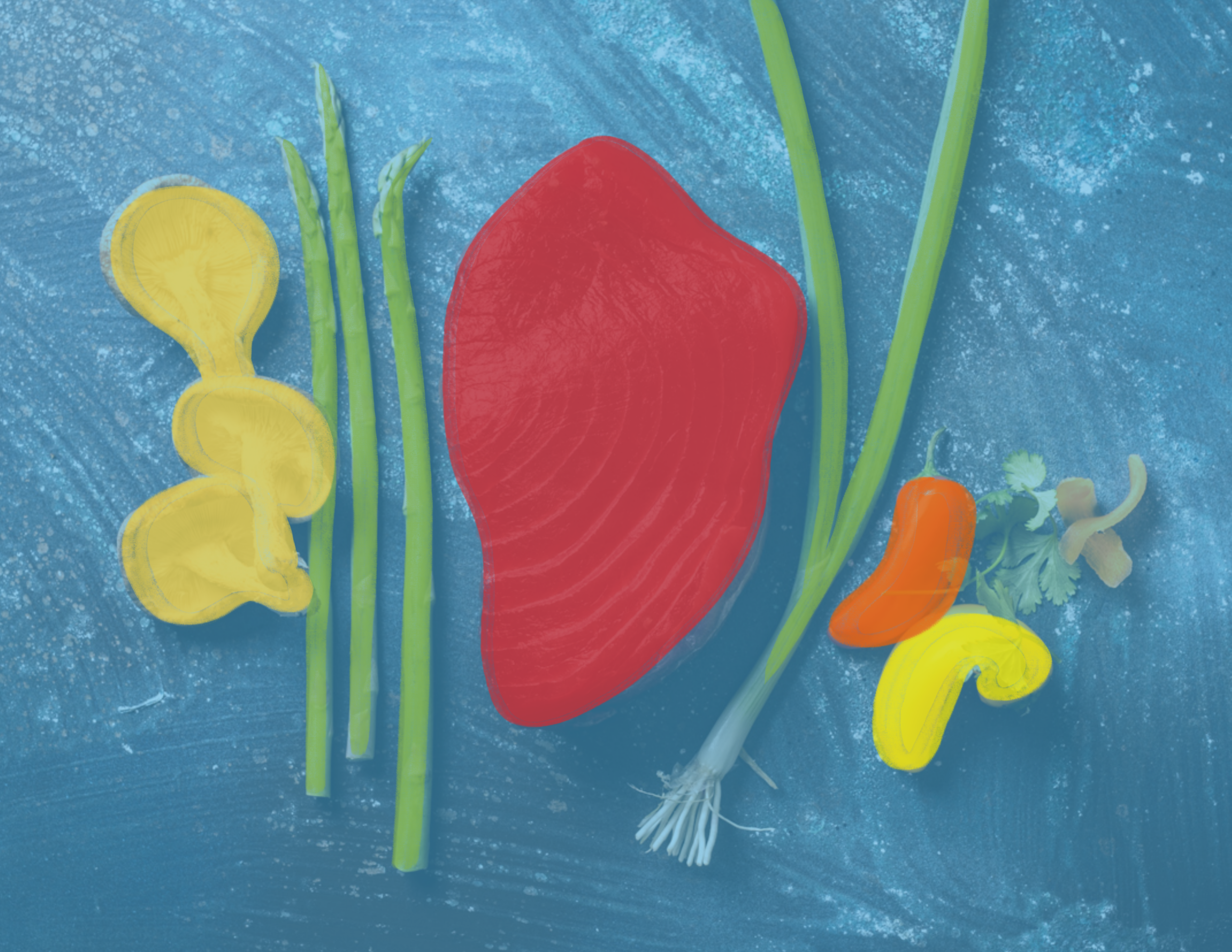
In this photo, the bright and warm colors of the produce pop out and are eye catching against the contrasting blue surface.
Pattern
While it is not recognized as one of the classic elements of design, pattern has taken on an important role in modern photography.
This is because a pattern can be man made or it can be naturally occurring. As humans, it is in our nature to seek order and to try and establish patterns, so as a visual element in photography, it can be quite appealing to the eye.
It’s even possible that a pattern is the very inspiration behind a photo because it immediately attracts interest and its repetitive quality can help unify an image. A pattern occurs when elements or shapes combine and are repeated in a regular/recurring arrangement.
Patterns can make a strong statement or help tie elements of a photo together with regularity.
This photo is an example of a pattern stealing the show. Each apple slice is stacked with the same elements all arranged equidistant from each other, creating a pattern. It's intriguing enough that no real props are needed!